

Between 2022–2024, designers were cut at 1.7x the expected rate, and UX researchers at 3x, when compared to engineers.
Meanwhile, there is consistent data that good design leads to good business. Organizations that successfully integrate design into their core operations outperform the S&P 500 by 211% over a 10-year period. Every $1 invested in UX brings $100 in return. Top-quartile design performers increase their revenues and total returns to shareholders (TRS) at nearly 2x the rate of their industry counterparts. This holds true across all industries, from banking to medical devices.
So why do design teams suffer from layoffs more than any other in the tech industry? Because in a high-interest-rate environment, ambiguity is expensive. If Design function fails to prove itself an asset, it will be cut like an expense.
It starts with design leadership and the ability to map design outputs to revenue. Shifting the mindset from “protecting the user from the business” to “growing the business through users”. Growing your own skillset from a a design function to product strategy.
Below is an operational model and a practical canvas for Design Leaders to navigate a precarious intersection between creative intuition and empirical scrutiny, future proof their teams against executive subjectivity, and, ultimately, strengthen their influence while creating and scaling a high-performing design teams.
Product Design is not “making things pretty” or “creating delightful experiences”, design is a lever for growing a business. Full stop. Good design is about prioritizing which lever to push and a string to pull to move the business up and to the right. To do so, design leaders must understand the business itself, the revenue model, and the nuances of each business units.
Design Leaders must shift its operating model from “protecting the user from the business” to “growing the business through the user”. When design goals align with revenue goals, it stops being perceived as a cost centre and a blocker to speed, and gains valuable resources and a strategic seat at the table.
To protect design function against market volatility and political vulnerability, Design Leaders have to understand the perspective of a CFO.
Their job is to minimize and optimize OpEx (Operating Expense): the incurred cost to run the daily business. Unlike manufacturing equipment or real estate, design is a predominantly an intangible asset, so it frequently falls into the OpEx bucket, making it vulnerable to budget cuts.
On the other hand, CapEx (Capital Expenditure) is advantageous as it moves the cost from the P&L to the Balance Sheet, amortizing it over time. CFOs are far more willing to approve projects that build long-term assets.
A VP of Design shifts the team’s focus from ‘Exploration’ (OpEx) to ‘Production Assets’ (CapEx). For example, a Design System isn’t just a style guide; it is codified infrastructure that reduces engineering cycle time. When packaged correctly, this allows Finance to capitalize the effort, moving design from a short-term cost to a long-term investment on the balance sheet.
Moreover, as a Design Leader, you must learn the art of profitable trade-offs, not just user advocacy.
Data has always been the panacea for subjectivity. Without data, design is just an opinion, and in the battle of opinions, highest-paid person always wins.
As a Design Leader, you need to be bilingual: speak Design to your design team, and Business to your stakeholders. This means changing your narrative from output metrics (e.g. number of screens designed) to impact frameworks (what design enabled). For example, instead of saying “This design had higher satisfaction scores” to “Time to goal completion was reduced by 15%”.
Shipping products is not a conveyer belt, where Product orders the feature, Design cooks it, and Engineering delivers it. The highest-performing teams operate as a “Product Trio” where Design, Product, and Engineering co-create strategy from day one. It is also the best antidote to executive subjectivity and design by committee.
Similarly, Design Leaders cannot move up to Strategic Impact without having strong relationships with their leader counterparts from Product, Engineering, Data Science, Marketing, Sales, Finance departments.
Lend your skills, knowledge, and experience to collectively reach the goals you are accountable for. Sometimes that means closing gaps in others’ skillsets or knowledge; other times, it means asking questions to fill your own.

Assuming data tracking implementation and data analysis are well-established functions, how does one map design output to growth levers? In an ocean of data, it’s easy to focus on the wrong data points, and miss the forest for the trees altogether. I argue that Design Leaders must abandon the generic list of metrics and adopt a narrative framework that links Product Design Work directly to Business Confidence.
This traditional funnel (Acquisition -> Activation -> Retention -> Revenue -> Referral) is an extractive model; it views the user as an ore to be mined. A design-led approach reframes this as a “Confidence Architecture,” where the goal of each stage is to build sufficient trust to move the user to the next level of relationship.
In this framework, we distinguish between Direct Levers (the hard business metrics that executives monitor) and Confidence Levers (the psychological and experience-based outcomes). The thesis is that you cannot sustainably move a Direct Lever without pulling the corresponding Confidence Lever.
In this example, I’m using traditional funnel steps, but you can adopt it to your stages that lead to the “North Star” metric (e.g. a purchase, a sign up, membership upgrade, etc).
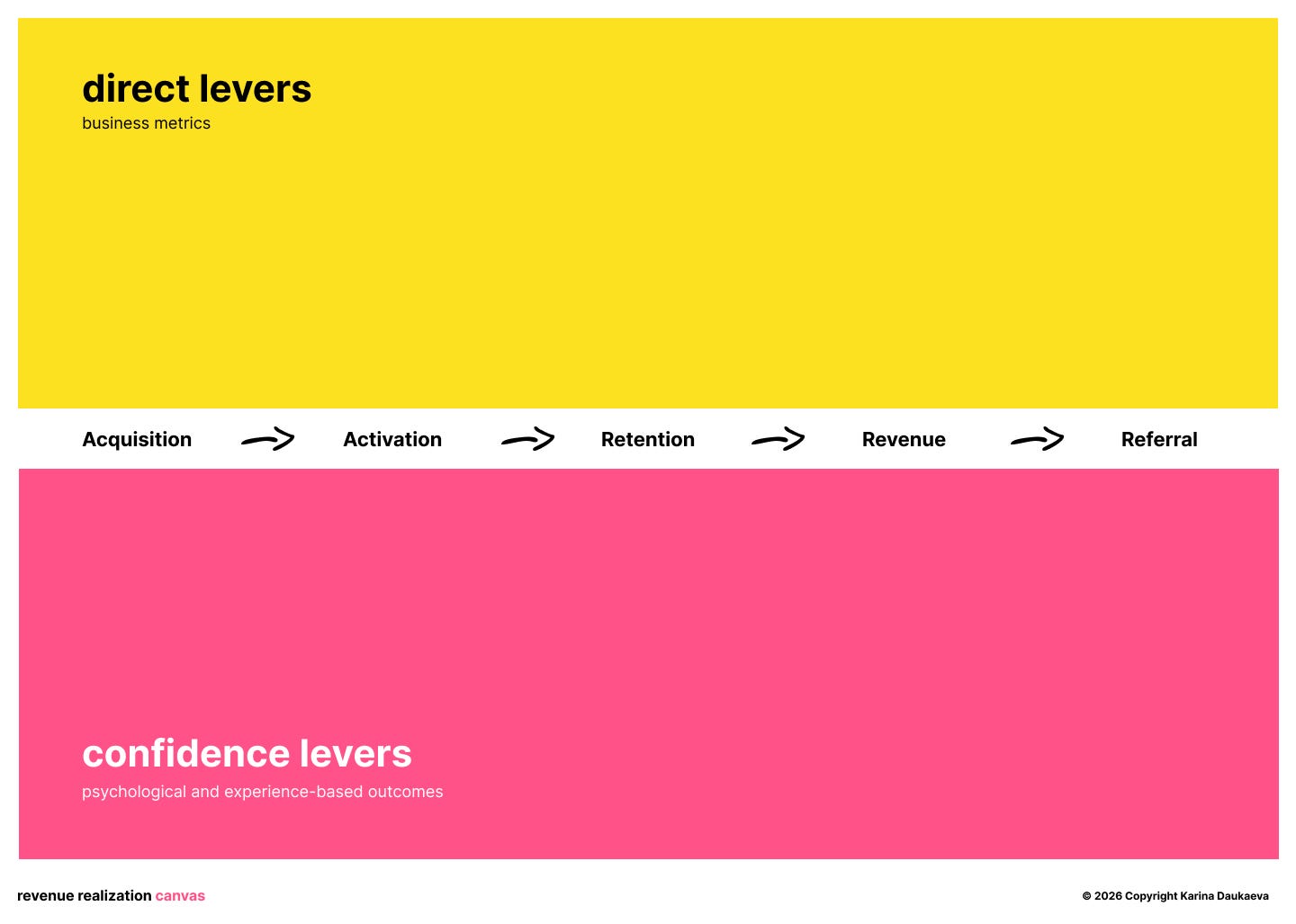
Here is an example to help you distinguish between a direct lever and a confidence lever.
In the traditional funnel, Activation is often treated as a binary gate: Did the user complete the onboarding checklist? This leads to “metric hacking” where teams insert forced walkthroughs or aggressive tooltips to artificially inflate completion rates without ensuring the user actually learned anything.
The Direct Lever: Time-to-Value (TTV)
The Confidence Lever: User Competence
When you pull the Competence lever (user feels smart), the Time-to-Value lever moves sustainably because the user wants to explore, rather than being forced to.

The Revenue Realization Canvas is not a static template; it is a living document. To make it effective, you must populate it with your organization’s specific reality. This requires a collaborative session — ideally with your Product Trio — to replace generic labels with your actual business truths.
Below is an example of how you could run this workshop and the key outcome at the bottom: a list of actionable design outputs that are directly mapped to business growth.

Use the following prompts to facilitate that workshop. The goal is to move the conversation from “what are we building?” to “what behaviour are we driving?”
The goal here is to articulate the human experience required to move the business metric. This is where Design translates empathy into strategy.
Finally, validate the connection. You must ensure that pulling the Confidence Lever will actually move the Direct Lever.
The days of the design leader as the “empathetic artist” are fading; the era of the Design Architect has arrived. We are no longer here just to advocate for the user; we are here to architect the profitability of the business. By translating “confidence” into conversion, we do more than just make the product usable — we make the business model sustainable. This is the mandate for the modern design executive: to stop treating design as a service bureau for tickets, and start wielding it as the most capital-efficient lever for enterprise value on the balance sheet. The operational model and a practical tool is here for you to use. Give it a whirl!